We’re More Educated Than Ever. So Why Is Anti-Intellectualism on the Rise?
Wanting a degree that leads to a job is reasonable. Making salary our measure of intelligence is where I have a problem.
I can open an academic paper on my phone, watch a university lecture, or start learning a language spoken thousands of miles away. I can use the same phone to hear six people explain why historians are useless and why my breakfast is killing me. Usually before breakfast.
I thought about making this essay a short video. Then I realized I’d spend the first five seconds trying to stop someone from scrolling and the rest rushing toward a conclusion. Writing gave me room to notice where my argument was too easy.
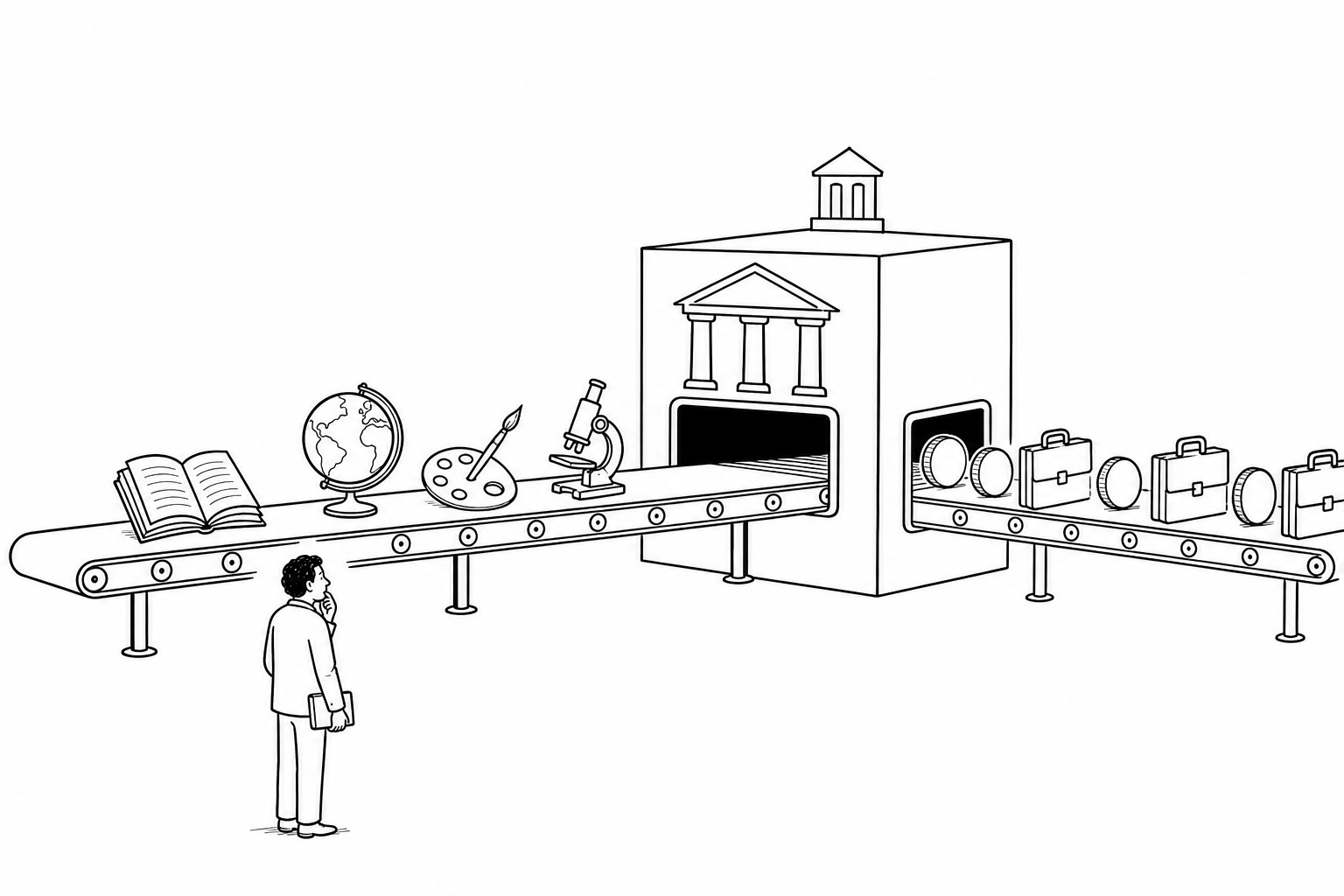
What bothered me was a familiar division: knowledge that makes money, and knowledge that has to defend its existence.
Will this get you a job?
I’ve seen this hierarchy in many Middle Eastern families. Ask what a successful child should become and the approved answers arrive quickly: a doctor or an engineer. Maybe a lawyer, if negotiations go well.
I understand the preference. A recognizable profession can mean security, especially for parents who have lived through economic uncertainty. It gives the family a future they can picture and a job title that needs no explanation at dinner.
The trouble begins when that preference becomes a verdict on everyone else. Choosing history means wasting your intelligence. Art is encouraged until you take it seriously. Writing is admired, provided you first become something respectable.
We imply that these people’s intelligence is unusable. Knowledge without an obvious salary becomes a hobby. Curiosity needs a business model.
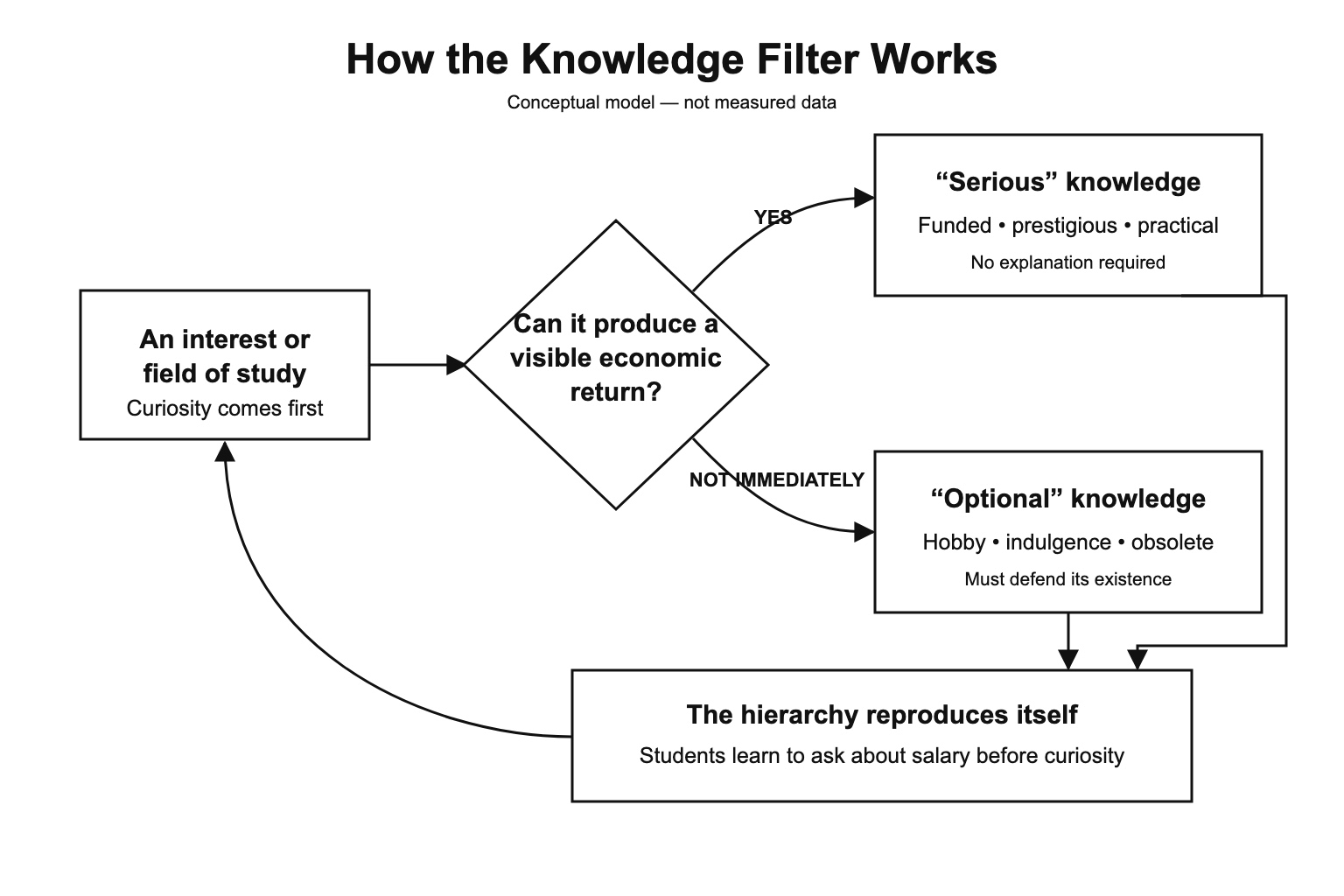
The funny thing is that this logic eventually turns on science too. Research with no immediate commercial use has to make the same awkward pitch as philosophy.
My first draft was harsher on STEM. That was unfair. Plenty of scientists and engineers do work that plainly benefits the public. What still bothers me is how much talent goes toward making advertisements harder to ignore while other problems remain badly served.
Technical ability helps us build something. Deciding what deserves to be built, and who should benefit, takes judgment that no single field can supply.
The expert has caveats
I liked early YouTube for its strange animations, clumsy sketches, and obsessive explanations made for an apparent audience of eleven. People uploaded because making the video was the point.
YouTube began sharing advertising revenue with creators in 2007. That gave people careers. It also put a second question beside “What do I want to make?”: “Will it perform?” A brilliant video now has to negotiate with the dashboard.
The pressure on education feels familiar. When the reward is easy to measure, the pursuit starts organizing itself around it.
Audiences face a related problem. An expert offers caveats and asks for better evidence. Someone else offers a complete explanation, a protocol, and perfect lighting. Certainty is easier to sell.
That doesn’t mean asking questions is anti-intellectual. Institutions make mistakes. Experts should explain themselves. But questioning a claim takes more effort than deciding expertise is worthless.
Trust also has a less tidy story than my title suggests. Pew found that Americans’ confidence in scientists fell between 2020 and 2024, but recovered slightly in the final year. That doesn’t prove career-focused education caused distrust. I think treating knowledge mainly as a product makes us impatient with the uncertainty that learning requires.
What education is for
A person can get an A in physics and know almost nothing about the political system governing their life. Someone can write beautiful code and remain historically helpless. A difficult degree doesn’t exempt us from learning how to examine an argument.
AI makes the gap especially obvious. We can build systems that write, imitate voices, and make decisions about people. Then someone has to decide which uses are acceptable.
A model can perform well on a test and still be wrong for a classroom or a court. Who can challenge its decision? Who answers when it causes harm? Faster software can’t settle those questions for us.
This is why I keep returning to AI governance. Understanding the technology matters. So does understanding the institutions and people it will affect. The supposedly impractical subjects become very practical once someone has to write the rules.
Wanting a degree that leads to a job is reasonable. I just don’t want a salary to become our entire explanation of what an education is worth.
We should be able to keep learning something before knowing what it will earn.
P.S. What is the most impractical subject you are currently obsessed with? I’m looking for something new to read when I should probably be doing something profitable.
References and evidence
- YouTube’s Partner Program
- YouTube’s December 2007 announcement describes its revenue-sharing pilot and expansion. The comparison with education is my interpretation.
- Pew: trust in scientists
- Confidence was 87% in April 2020, 73% in 2023, and 76% in 2024. This is a U.S. survey, not evidence of a worldwide trend or its causes.